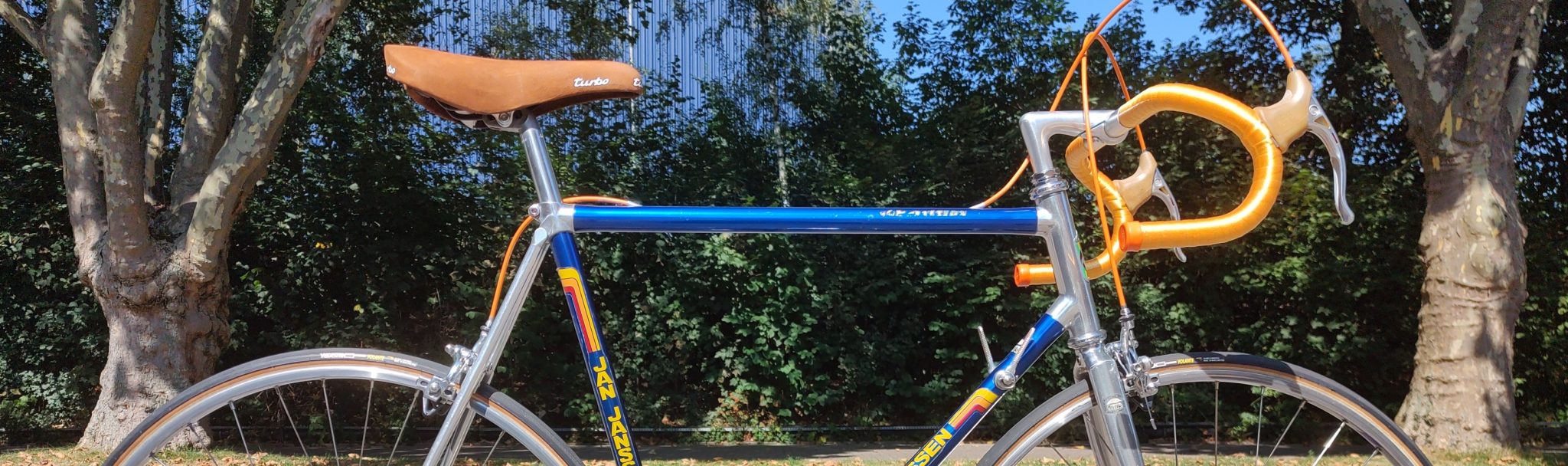
Most classic road bike enthusiasts picture a steel frame, usually from Italy or France, with a period Campagnolo or Simplex groupset. Aluminium tends to bring to mind the less graceful frames that were everywhere in the 1990s.
Vitus was already pioneering aluminium frame construction in the late 1970s. It used this light material to build classic road bike frames that became part of cycling history. I will cover the history of the Vitus 979 in more detail in a separate article.
This is a Vitus 979 from the first half of the 1980s. Many brands bought Vitus frames and sold them under their own names. This one wears Jan Janssen decals. The traditional seat clamp dates it to the first half of the decade. The familiar grub screw arrived for the 1985–86 season.
When I bought this Jan Janssen frame I already had around fifteen Vitus framesets. My plan was to clean, polish and sell them. After selling a few, I decided to build one for myself and chose this Jan Janssen Competition frameset.
First I inspected the frame thoroughly and started cleaning it. It had probably spent ten to twenty years in storage.
Here is how it looked when I bought it. The aluminium had dulled and several steel parts had developed light surface rust.
After a few hours of cleaning and polishing, the frame’s potential was clear. It has the classic proportions of steel even though it is made of aluminium. The polished anodised tubes have a shine that paint usually only achieves over chrome or with a special finish. The aluminium lugs also look remarkable when polished. I was already beginning to regret selling those other Vitus 979 and 992 frames.
I chose one of my favourite groupsets of the period, Campagnolo Nuovo Record. I wanted a mirror finish throughout, with custom-machined details and carefully chosen colour accents.
I finished the parts before building the bike. I stripped the brake callipers, removed the anodising, polished the bare aluminium and reassembled them. I replaced the old shoes with lighter original aluminium Campagnolo Record shoes and installed new original Campagnolo pads.
The next components were to be machined and colour-matched, beginning with the crankset on the CNC mill.
I fluted the crank arm and the arms of the spider, much like a Colnago Mexico crank. There is a video and a photo of this step.
At the time I ran the mill by remote control.
Here is the crank arm being machined. The spider arms had already been fluted:
After machining both crank arms I polished the crankset and filled the recesses with colours that match the frame: red, orange and yellow.
Next I personalised the Nuovo Record brake levers by opening up the front and sides.
Here is a video of that work:
I polished the levers, added colour to the machined details and fitted new original Campagnolo hoods in brown.
I also polished and machined the Campagnolo Nuovo Record seatpost. The front derailleur kept its original silver finish, while the rear derailleur and shifters received matching colour details.
That completed the work on the Campagnolo components.
I wanted the remaining parts to match the quality of the Campagnolo Record group. I chose a near-new Cinelli handlebar and stem.
The wheels use polished high-flange Campagnolo Nuovo Record hubs and silver Campagnolo Lambda Strada rims. I fitted new-old-stock Vredestein Volante folding tyres with beige sidewalls to match the hoods and saddle.
I wanted glossy Benotto bar tape. After considering the tape and housings together, I chose orange instead of yellow. It suits the rest of the bike perfectly.
The saddle is a new Selle Italia Turbo in a classic brown finish.
After debating silver or gold for the chain, I chose gold to suit the colour scheme. The Sachs Sedis Oro is one of my favourite classic road chains. This one had waited decades in its original packaging.
With the parts ready, I installed the Campagnolo Nuovo Record headset to join frame and fork. I used new bearing balls and the proper tools.
I installed the components one by one and wrapped the bars. Assembly is always rewarding after spending so long preparing and polishing the parts.
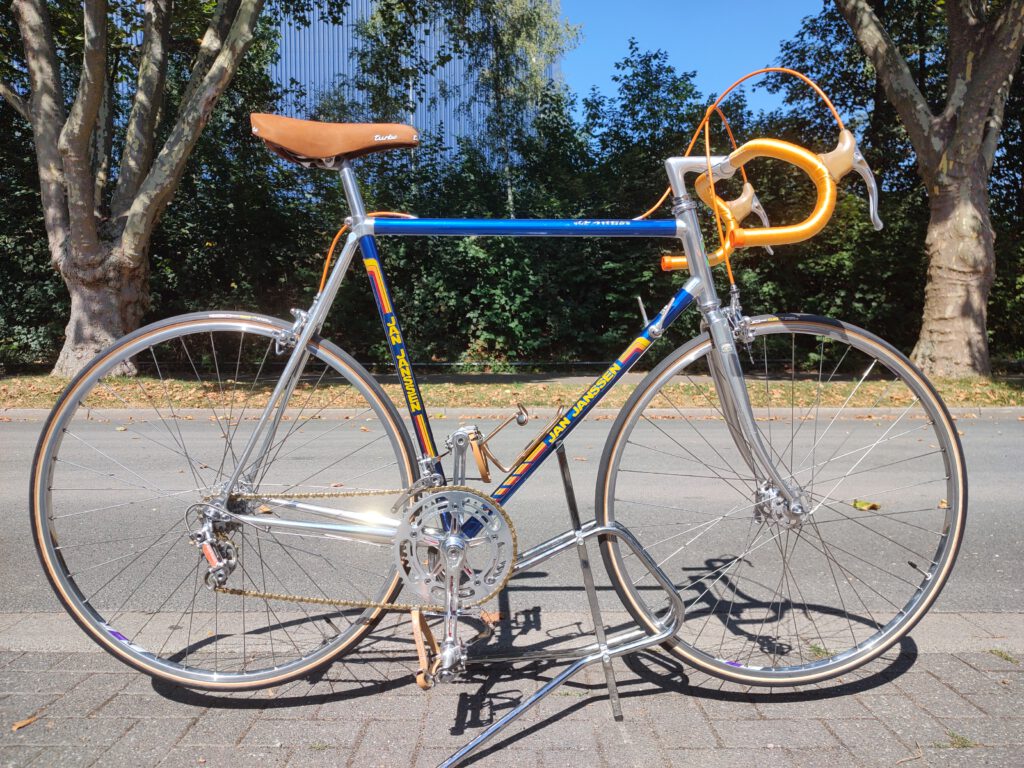


I went with orange cable housings, which bring the parts together nicely. The pedals are Campagnolo Super Record Superleggeri with new brown Christophe leather straps.
The frame measures 58 cm centre to top.
At the time of writing, the complete specification and more photos were available through the shop while the bike was listed. The new owner gets an individual classic road bike, comprehensively restored to near-new condition and with a look all its own.
Just get on and ride. It feels remarkably light.